mostly downtown, in black and white.
–
–

–
–
–
–

–
–

–
–
–
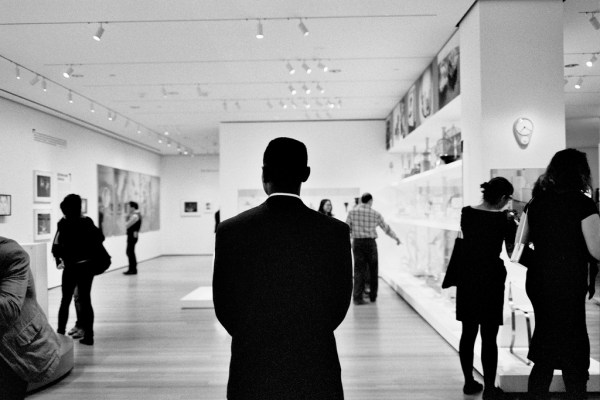
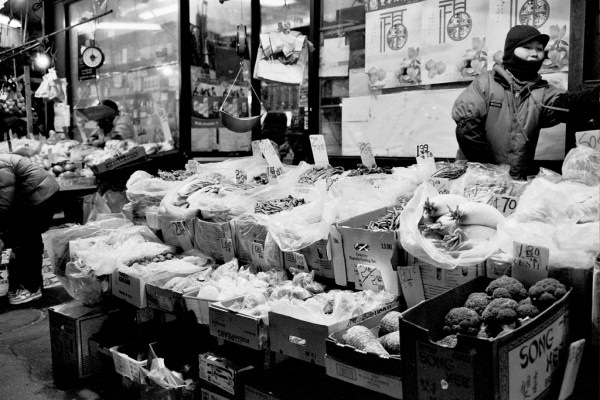
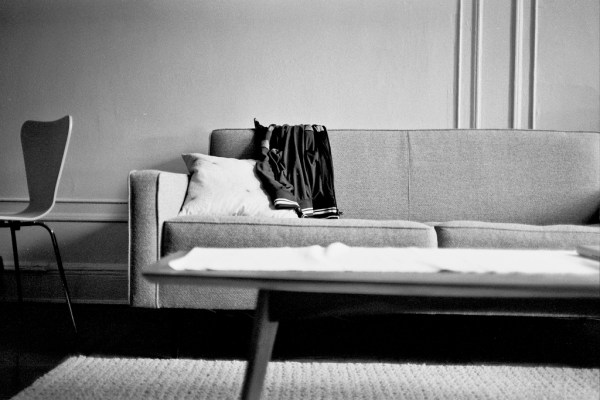
–Okay, so the very top one was taken at MoMA. And the bottom one is in Prospect Heights. But all of the other photographs — including ones of my deal friends Michael (visiting from Toronto) and Shannon, shot on Fuji Neopan 400 with the Zeiss Biogon, on Peter’s Leica — were taken below Houston Street. Leicas love black and white, goodness me!
Speaking of which: my Leica finally has a name. More on that soon.
downtown.
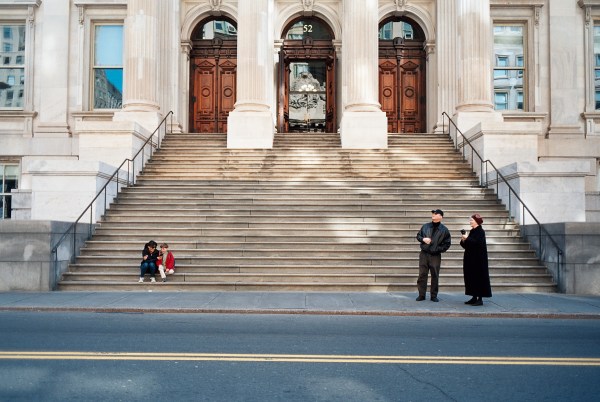
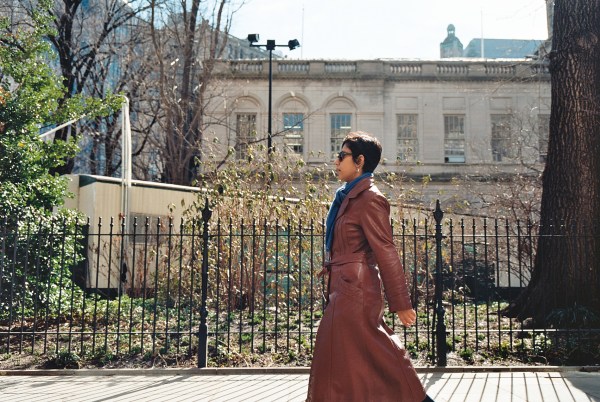

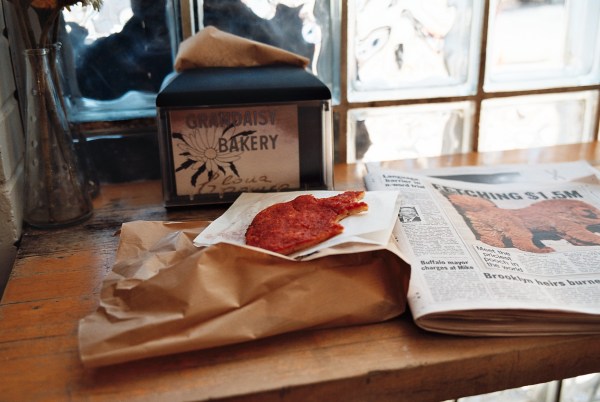
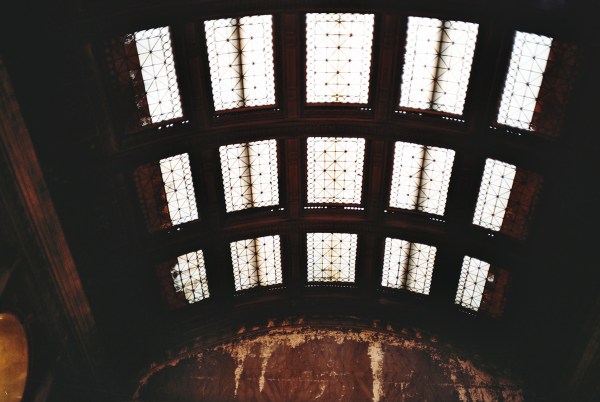
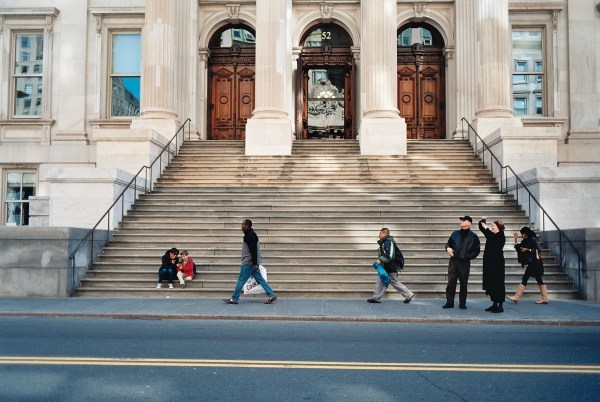
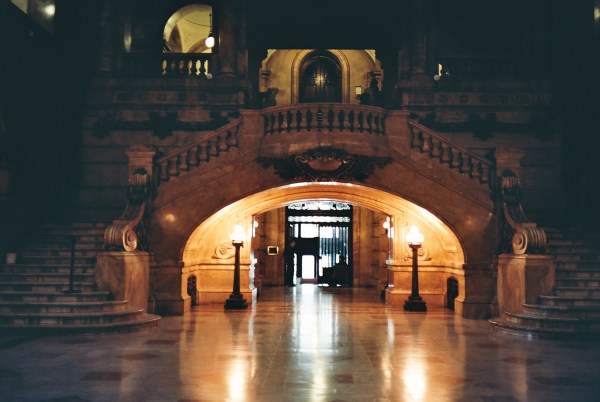
So here’s the new Leica, showing off its moves during a couple of visits downtown this week. Pretty sharp, eh?
Also: have you been inside the Surrogates Court building on Chambers Street? Sweet Jesus, wander in there some time and just stand in the atrium. It is gorgeous. The photo immediately above doesn’t do the space justice; this is old New York in the grandest of ways. (Be sure to look up at the skylight, too.)
It’s been a busy week, and I haven’t had a chance yet to take advantage of the extra hour of daylight. I’m hoping this weekend will provide me with much light, if not warmth — although it’s a glorious 70 degrees today, it’s only going to be in the fifties the next couple of days. Lots of food in the near future as well, so I’ll have a chance to see how the Biogon lens + the new Leica fare at mealtime.
the magic.


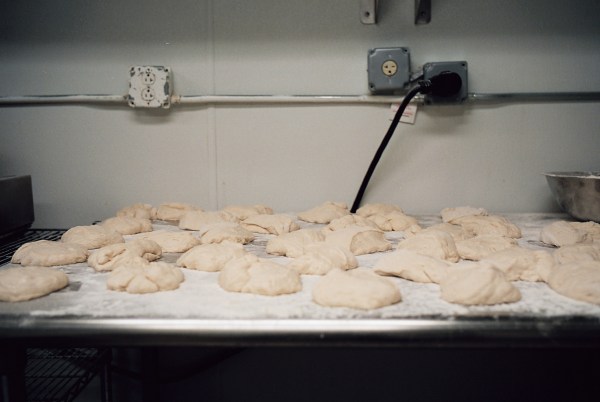

This is where it happens. The magic, that is. Some of the best pizza crust in the city starts here, folks: the borrowed Leica and I got a peek at the downstairs prep kitchen at Co., where my pal Brendan spent a recent Saturday afternoon getting the pizza dough ready for its second (?) rise.

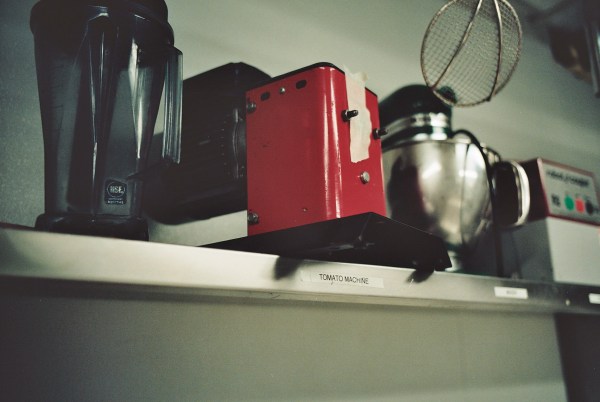
Also, there is something in the world called a Tomato Machine. It ‘s like a high-powered tomato peeler/de-seeder – apparently it can mill 330lbs of tomatoes in an hour! I know what’s going on my birthday wishlist.
Below: a Rosa pie, in all its crusty, cheeseless, post-tomato-machine glory.

the new arrival.

Yup.
Monday should’ve been a pretty glorious day for me. With the time change, there would be an extra hour of sunlight to take advantage of. And! The new Leica arrived! Hooray! Over the weekend, I’d made grand plans to hit B&H for film and batteries, so I’d be ready for the big delivery. But then I got caught in various things — some good (brunch at Bocca Lupo, the FA cup match between Manchester United and Arsenal, a hilarious wurst competition at MoMA) and one incredibly bad (Battle: LA (er, sorry about that, Mark)) — and B&H would have to wait until Monday afternoon, after I’d already received the Leica. Not a problem.
That was the plan, anyway. But then on Sunday evening, I helped Mark move a credenza into his new place. While I was still nursing a pulled tendon. Monday came around, and, well, yeah. Or I mean … no. Bruised, sore, and having re-strained my halfway-healed tendon, I could barely move. The Leica came — hooray! — but sadly, all I could do was stare longingly at it. B&H was out of the question — I looked like a broken marionette on Monday afternoon, hobbling down the office corridor, hopped up on as much Advil as my body could take. And so the Leica would remain in its box, waiting for a happier day to come around.
It’s Wednesday now, and several Codeine tablets later, I’m nearly back on track. I managed to limp my way to B&H on Tuesday afternoon, and now the Leica’s all set, battery and film-wise. Though now, of course, the weather has decided to be exceptionally uncooperative. It’ll probably be another day or two until I’m pain-free and able to walk without eliciting stares, and hey!, it’s supposed to be nearly 70 degrees on Friday. So I guess the Leica’s big debut will have to wait until then.
In the meanwhile: any name suggestions for the new kid on the block?
biogon test roll, take two.


This past Saturday gave me an opportunity to test out my new Zeiss ZM-Biogon 35/2 lens under much-better-than-overcast conditions. Lovely, fair, mid-50s, sunny weather, in fact. Mark and I headed to Bocca Lupo over in Cobble Hill for brunch — the huge windows flooded the room with great light. The Biogon seems pretty sharp in this light; not nearly as tight as the Summicron, but much better optics than my Nikkor or Super Takumar. Then again, my SLR lenses and cameras do a much better job of getting up nice and close for food shots, so I suppose there’s always a tradeoff — SLRs for food, and the Leica for just about everything else, perhaps. The color contrast with the Biogon at f/2 is pretty great, maybe not as contrast-y as the Summicron, but much more so than a lot of the photos I’d seen on Flickr taken by other Biogon users. (The Ektar no doubt helps a bit in that regard.) Do I miss the lack of the fabled Leica glow in the photos? Maybe a little bit, but not enough to regret buying the Biogon, and certainly not enough to plunk down the $3k for a Summicron of my own.
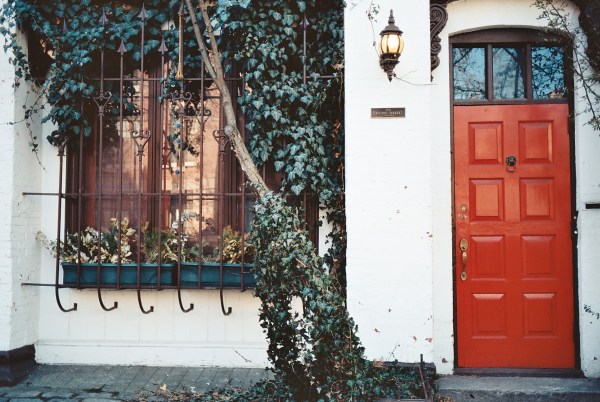
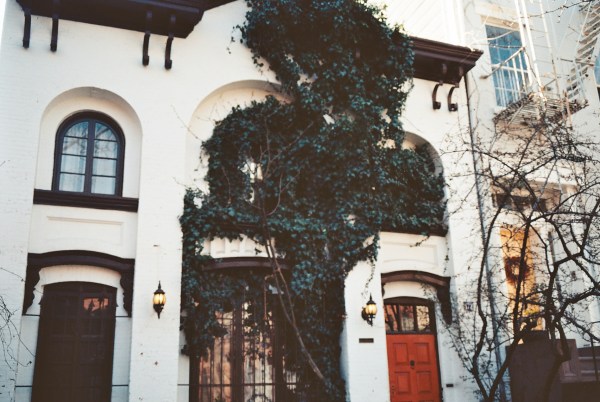
On the walk over to brunch, Mark and I stumbled upon a house that neither of us had seen before, not in the daytime anyway. We decided it was perhaps the best house in the neighborhood; I would almost say in all of Brooklyn, but all of those big Victorian houses in Kensington might take the collective cake. But a wee house like this, an actual standalone house, in the middle of brownstone Brooklyn, is always a nice surprise, especially one this lovely.
11 march.

This is my nephew Eli, back when he was just a month old, in November 2008. He’s much bigger now, and a big brother to boot. (Hi, Alia!) Eli and Alia live with my brother and his wife in Kobe, Japan; my brother does a slightly insane commute to Shanghai, where he works as an architect. They’re all coming back to the States next month, where I’ll finally get to meet wee Alia for the first time, and Eli, now a talkative toddler, and I can have long philosophical chats about what it’s like to be an older sibling. Though probably we’ll just talk about trucks.
I got word this morning from my brother (currently in Shanghai) that my sister-in-law, the kids, and her parents, are all safe and sound in Kobe following the catastrophic earthquake and subsequent tsunami off the northeastern coast of Japan late last night. I’m sending good thoughts and much hope to everyone over there who has been affected by this, and condolences to everyone who lost a loved one.
biogon test roll.

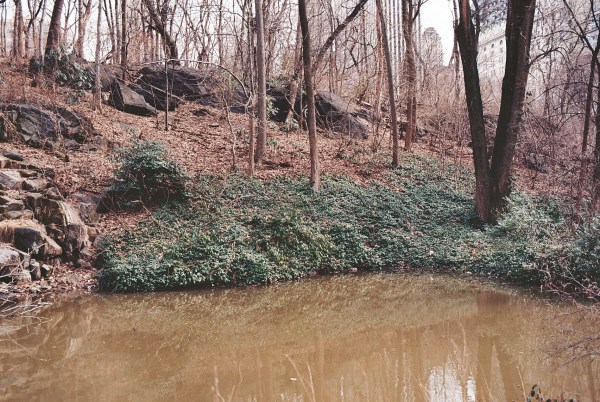

So here it is, part one of OK Yes I’m Going To Do This No Seriously I Am: test photos from my new Zeiss Biogon 35mm f/2 lens,. This weekend, part two happens: purchasing a Leica of my very own. I figured I’d take advantage of my last days with my friend Peter’s Leica M6 to test out the Biogon, to get a feel for its focusing mechanism (not as loose and zippy as the Summicron, alas) and its aperture settings (zounds, yes!). So after the lens arrived at my office today, I spent my lunch break in Central Park, on one of those days that alternates between ovecast and overcast with occasional evidence of sun. Not the best day, or the best location, to test out the lens, but what can you do?
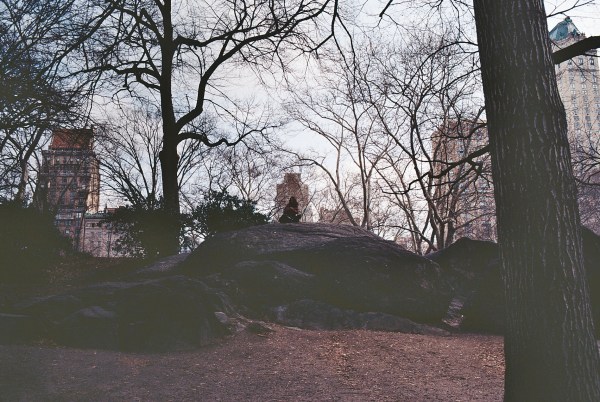
Despite the park’s pre-spring monotones and just about everything feeling washed out, I think I got a handful of decent shots. The Ektar didn’t pop as much as usual, but then again, the color palate I had to work with was limited at best. The two shots below, taken seconds apart and with slightly different aperture openings, are probably my favorite. The first one was taken at the correct exposure; the bottom one at I think f/5.6, maybe a full stop down. There are great warm tones in the first, and I know it’s the better photo of the two, but the underexposure in the second brings out more of the Ektar blues that I love so much. I’m going to have to explore this Ektar-Biogon calculus a bit more!
And in both photos I like to imagine that it’s Patti Smith sitting atop that rock.

a fortune for the undertow.

[Matt, on Parrish Beach, 1994 or 1996, taken with the old Pentax K-1000]
My best friend Matt and I were emailing the other day, both of us mildly horrified by the fact that next year, we’ll be attending our respective 20-year high school reunions. 20 years. But then it occurred to me: if I’ve been out of high school that long, that means that I’ve also known Matt for 20 years, too. And that was a particularly gratifying feeling. More than gratifying, actually. Sublimely comforting, in fact: I’ve known Matt for more than half my life. In 2012, our friendship will have existed for longer than it hasn’t.
Matt and I met the first day of freshman orientation in college. We skipped out on half of the orientation events, opting instead to hang out in Matt’s dorm room to listen to music and chat the afternoons away. In October of that year, we headed out one Tuesday afternoon to go to the mall; REM’s Automatic for the People had just been released that day. We got back to campus, CDs in tow, and spent the waning daylight hours listening to an album that was full of grace and aching beauty. And we both had — and shared — a favorite track, Find the River, the last track on the album.
Do you know this song? Sweet jesus, this song is …. just about perfect. (Until I can get this blasted audio player to work properly, you can listen to the track here, though I’d advise against actually watching it, unless you like the idea of Michael Stipe sporting unfortunate facial hair and a baseball cap backwards. No, really.)
I could go on and on about all the different things I love about this song, from the lyrics to the arrangement, to the way it goes from quiet to soaring to quiet again. I read back around the time that the album was released that Mike Mills and Bill Berry intentionally recorded their vocal harmonies blind — they had no idea how the other, or Michael Stipe, had sung his part, so each person just sang however he thought was appropriate to the basic song at hand. And what resulted was just gorgeous.
But what I love most about this song is that, of all of my favorite songs in the world, this is the only one I share with someone else. All of my other favorite songs — and there are about five, I’d say — I love deeply, but it’s sort of a private love affair, just me and the songs. But this is the only song that, whenever I hear it, I never ever fail to think of one other person. And it’s been this way for nearly 20 years now. If Matt and I are both fortunate enough to have a 50 years from now, I hope that this remains the case.
To be sure, Matt and I will always have Swing Kids too, but that’s an entirely different story.
All of this is coming your way.
alphaville.

–
–

–
That’s what these photos remind me of, anyway: stills from Godard’s Alphaville. (All we’re missing is Anna Karina flitting on by with her big eyes breaking down the fourth wall.) Daniel, though, says that the second photo reminds him of old photos of New York City in the 1950s, which I can also see as well. I love how black and white film almost always already dates a scene, placing it in a noirish past or mysterious future.
In any event, this is what Brooklyn looks like, around the corner of St. Marks and Flatbush Avenue, just after 6pm in late February, on my way to James, the lovely restaurant in Prospect Heights that serves a great burger in a gorgeous space. (More photos from that meal soon.) I’m looking forward to the 6 o’clocks in May and June, with more light and longer shadows, and glasses of Gruner Veltliner al fresco.
the end.
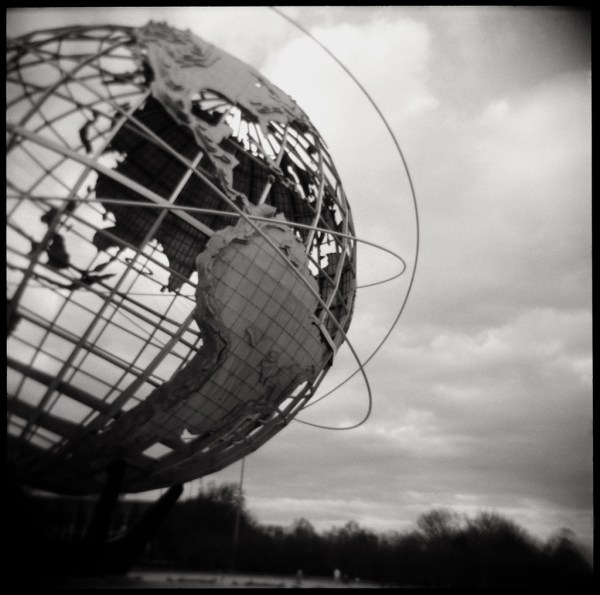
[Unisphere, Queens | Fall 2008. Taken with my sometimes-impossible, but still wonderful, Holga, which I’m realizing now needs a proper name, like Pony the Yashica and No-Name the Nikon. That last clause made me sound crazy.]
Look, it’s like this: I don’t begrudge digital photo takers. For a long time, before I switched to film full-time, I really wanted to get a proper DSLR, a nice Nikon D90 or something, not crazy fancy but still, you know, something like that. And my friends who do have DSLRs take some of my favorite photos, ever. And it’s not that I think that there’s a bright line dividing film and digital photography; in the end, it’s how you see the world, and not the equipment you use to capture it, that defines your vision. That said…
The proliferation of iPhone and Droid apps, like Instagram and Hipstamatic, make it possible to put lovely color filters and effects on captured moments, rendering those moments more gauzy, dreamy, hyper (or under) saturated, and so on. I use Hipstamatic every now and then, to take food photos when the lighting would otherwise render a film photo completely terrible. And I use Hipstamatic, rather than just take the photo with my camera, sans app, because I don’t like the washed outness, the flatness, of the plain digital photo; there’s no depth of field, no aperture control, and so in lieu of that, a pretty effect will do. I get it. I totally get why people love these apps. It makes everything so … lovely. The banal is transformed into something aesthetically pleasing. Fine. Yes.
And in the near-ish future, I’ll have more to say about Hipstamatic; I’ve been working on a longer piece for three months now. But for now, I’m writing because I’m pissed off. There is, apparently, a Holga lens you can buy for your DSLR, to give it that special “low-fidelity aesthetic” that’s all the rage now. And this is the fucking ridiculous copy that’s making me incredibly sad:
The installation of the HL-N adaptor to a Nikon camera will turn the clock back on your electronic box of tricks. What was once a hi-tech digital SLR now takes on all the characteristics that we have all come to love of our Holga’s. And now with none of the hassle or cost of developing and printing the film.
None of the ‘hassle’! Awesome! And … wow. (And, for the love of god, the plural of Holga is Holgas, not Holga’s.)
I’m too angry, apparently, at this attempt to woo the DSLRers who can afford a $1,000+ camera (plus all the fancy lenses) but can’t bother with the cost of buying the actual $20 Holga and $5 roll of film nor the unpredictability of light leaks and funny blurs, that all I can do is think laterally. And what came to mind was this: back in the 19th century, fake ruins were all the rage on English estates. Architects were brought in to design ornamental buildings that had limited, if any, functional purposes other than to appear half-decayed. This practice became popular after the start of the mid/late 18th century Grand Tour, a months-long rite of passage of sorts for aristocrats to make their way through the monumental highlights of continental Europe, including ruins-heavy Italy.
Back in England, delighted at the wonders they’d seen, people wanted to recreate that landscape on their own expansive lawns. These fake ruins — no, seriously, buildings half-completed, and then allowed to be run over with vines and shrubbery — gave the estates an extra sense of … well, whatever. Grandeur. Blah blah blah sublime. History. Monumentality. Significance. These follies were meant to reproduce, on a much smaller scale, and in a much quicker fashion than, say, 1500 years, the rise and fall, ebb and flow, x and y, of empires come and gone. An aesthetics of sublime decline, without the waiting around for the actual decline. An artificially-generated, (half-)built, insta-nostalgia.
Sure, my lateral moves take me to fairly predictable places (see: URL for this blog), but you get the point, no?
 hong-an tran